
- Read Time: 30 minutes
- Justin Oglesby
Video Sales Letters: How to Write a Proven VSL to Skyrocket Your Conversions & 5x Your Sales
In the highly competitive landscape of digital marketing, capturing and retaining audience attention has never been more crucial. One of the most effective ways to achieve this is through the strategic use of a video sales letter (VSL)
Unlike traditional sales methods, VSLs blend visual storytelling, persuasive copywriting, and strategic sales psychology into a concise video format, making it an incredibly powerful tool for increasing conversions, boosting sales, and enhancing customer engagement.
Businesses across diverse sectors have leveraged the power of VSLs to generate remarkable results. In fact, a single, carefully optimized VSL helped us generate over $10 million in revenue within the first two years in business.
We’ve also done this for almost every client and extensively studied data from more than 2,600 successful VSL campaigns across various industries, revealing consistent patterns and strategies that contribute to their high conversion rates.
Creating a successful VSL involves more than just recording a compelling video to convince someone. It requires understanding human psychology, mastering persuasive techniques used by top speakers and marketers, and meticulously structuring content to guide viewers from initial interest to decisive action.
We consistently receive questions on Video Sales Letters, have recorded multiple YouTube videos, developed a handful of assets, etc. Since it’s such a popular topic and an integral part of attracting clients online, we decided to write this article.
This was written to be an in-depth guide and resource for creating VSLs. We pull data from past results and continuously come back here to update the article to what’s currently working.
Enjoy!
What is a Video Sales Letter (VSL)?
A video sales letter (VSL) is a video specifically crafted to persuade viewers to take a specific action…usually to buy a product or service, book an appointment, or subscribe to an offer. At its core, a VSL is a sales pitch delivered through a video format.
It combines persuasive copywriting techniques, visual elements, and a compelling narrative to effectively guide potential customers toward a sale. The VSL’s meaning is straightforward: it’s essentially a modernized version of traditional written sales letters, presented in a dynamic and visually engaging way.
A VSL leverages storytelling, emotional triggers, social proof, and strategic calls to action, carefully structured to captivate and convert viewers.
In other words, it’s an asset to help sell what you offer.
Breaking Down the Concept: What is a VSL?
To clearly answer the question, “What is a VSL?”, it’s helpful to think of it as a persuasive presentation designed for online audiences. Typically placed on a landing page or sales funnel, a VSL guides viewers through stages of awareness, highlights problems, introduces solutions, and culminates in an irresistible offer or next step.
The format is highly effective because video allows creators to engage multiple senses simultaneously (audio, visual, and emotional), making the message memorable and impactful. Moreover, data consistently indicates that video content tends to convert at higher rates compared to traditional text-based sales pitches.
That’s because video can quickly build trust and convey authenticity.
Importance of a High-Converting VSL Video
Businesses use VSL videos primarily due to their ability to simplify complex offerings, significantly shorten sales cycles, and drastically reduce the amount of time spent dealing with unqualified leads.
Our own experiences underscore the effectiveness of VSLs. We’ve created over 2,700 VSLs, consistently seeing substantial boosts in conversion rates and overall sales performance.
Imagine running your business without a video sales letter. Prospects encountering your offerings may quickly become confused or overwhelmed by unclear or overly detailed information.
Without a clearly structured VSL to guide them, potential customers often get stuck at various stages of the decision-making process, prolonging sales cycles and increasing the risk of losing their interest altogether.
Moreover, without the precise qualification mechanisms embedded within a well-crafted VSL, your sales team could find itself bogged down with unqualified leads…individuals who are unclear about their needs or aren’t ready to commit.
This scenario inevitably leads to wasted resources, lost opportunities, and decreased efficiency. By contrast, high-converting VSL videos effectively:
- Streamline your sales process by clearly explaining your offer.
- Rapidly qualify leads, ensuring that only genuinely interested prospects advance through your funnel.
- Boost conversions by creating urgency and clearly demonstrating value.
The result? A shorter sales cycle, a higher conversion rate, and optimized productivity for your sales team. The strategic use of VSLs has enabled us and countless businesses we’ve worked with to achieve remarkable outcomes, including eight-figure revenue milestones.
The Different Types of VSLs
While many online resources promote a one-size-fits-all approach to VSLs, the reality is far more nuanced. To determine the most effective VSL structure, it’s crucial to understand two key marketing concepts: the Five Stages of Market Awareness and the Five Stages of Market Sophistication.
The 5 Stages of Market Awareness
Market awareness, a concept extensively outlined by Eugene Schwartz in his seminal book “Breakthrough Advertising,“ refers to how clearly your prospects understand their own problems, the solutions available, and specifically, how aware they are of your product or service.
Understanding the exact awareness stage of your prospect is crucial because it dictates precisely what you should say (and equally important, how you say it) in your messaging or marketing efforts.
When crafting your message, you must first determine:
- What does your prospect already know about their situation?
- What are their current beliefs about their problem?
- Do they understand that possible solutions exist, and if so, are they familiar with yours?
Clearly identifying the stage of awareness ensures your marketing efforts align directly with your audience’s current mindset, reducing friction and boosting the effectiveness of your message.
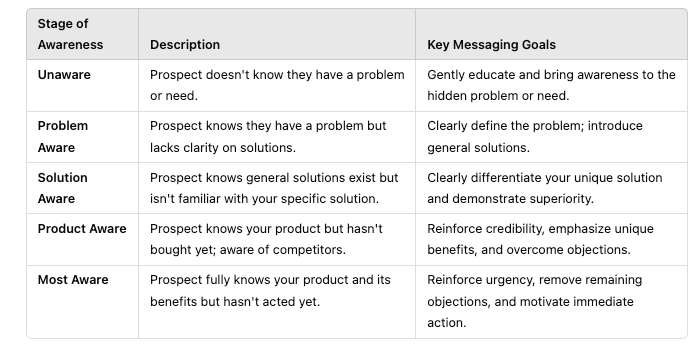
The five specific stages of market awareness include:
- Unaware: Prospects do not realize they have a problem. Your messaging should educate them gently about their unrecognized needs.
- Problem Aware: They recognize their problem but have little knowledge about possible solutions. Clarify their problem further and gently introduce solutions.
- Solution Aware: Prospects are aware of solutions but do not know your specific offering. Differentiate your product or service clearly.
- Product Aware: Prospects know your product but have not yet purchased. Highlight advantages over competitors and justify value.
- Most Aware: They know and want your product, but have yet to purchase. Messaging should reinforce urgency and overcome any remaining hesitations.
Summary: The Five Stages of Market Awareness:
The 5 Stages of Market Sophistication
Market sophistication, also articulated by Eugene Schwartz, addresses the maturity of a market, specifically how familiar prospects are with products or solutions similar to yours. It reflects how your audience perceives and responds to marketing messages and claims based on prior exposure.
Takeaway: The more experienced or saturated a market is, the more strategic and unique your messaging must be. Generic claims won’t cut it when your audience has “heard it all before.”
Understanding the sophistication level of your market is essential for accurately tailoring your marketing approach. It determines whether you should introduce a novel concept, focus on differentiation, highlight unique mechanisms, or appeal strongly to identity and emotion.
Pro Tip: Accurately identifying your market’s sophistication stage saves time and boosts conversions by helping you skip ineffective angles and focus on what resonates.
When defining your strategy, ask yourself:
- Has your market encountered similar products or solutions before?
- Have competitors saturated the market with claims, causing skepticism?
- Does your audience require deep education, or are they jaded by overexposure to similar offers?
Don’t Forget: Your answers shape not just the message, but also the format, tone, and depth of your marketing content.
Identifying the right sophistication stage lets you position your message to feel fresh, credible, and highly relevant. It ensures your product doesn’t just sound like more noise.
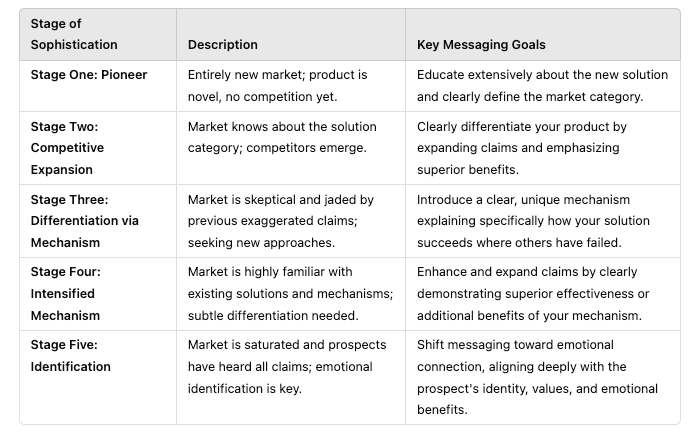
The five specific stages of market sophistication include:
- Stage One: The market is entirely new; extensive education about the product category and benefits is required.
- Stage Two: The market recognizes the category but still requires differentiation from competitors.
- Stage Three: The market knows the solutions but is skeptical. You must introduce a unique mechanism clearly and compellingly.
- Stage Four: Enhance existing claims by showing superior effectiveness or additional benefits of your unique mechanism.
- Stage Five: The market is highly saturated; emotional identification and alignment with the customer’s identity and values are critical.
Takeaway: Messaging that worked in Stage One will fall flat by Stage Five. Always adapt to where your audience is, not where you wish they were.
Summary: The Five Stages of Market Sophistication
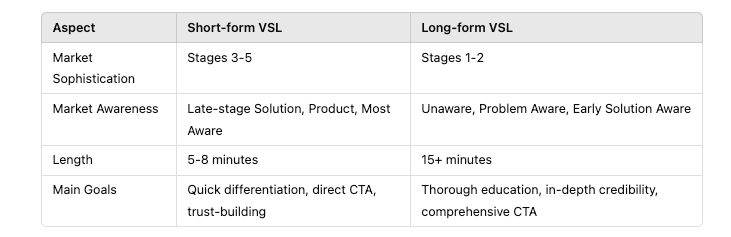
Short-form VSL (5-8 minutes)
This structure suits highly sophisticated markets (stages 3-5). It focuses quickly on unique mechanisms, emotional triggers, and clear calls to action:
- Big promise
- Social proof
- Twist the knife (address pain)
- Introduce the unique solution
- Visualization of success
- Immediate CTA with clear next steps
- Reinforcement and outro
Long-form VSL
Ideal for less sophisticated markets (stages 1-2), long-form VSLs educate extensively:
- Extended emotional and educational hooks
- Detailed explanations and comprehensive social proof
- Thorough solution demonstrations
- Extensive visualizations of results
- Comprehensive, repeated calls to action
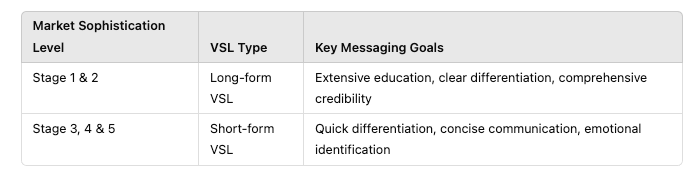
Choosing correctly between short and long-form VSLs ensures your message resonates effectively, maximizing conversions based on audience awareness and market sophistication.
Summary of Matching VSL Type to Market Sophistication:
By deeply understanding these frameworks, you can ensure your VSL speaks directly and effectively to your audience’s current level of awareness and sophistication, dramatically boosting your chances of capturing attention and converting prospects into paying customers.
Short-form VSL (5-8 minutes)
A Short-form Video Sales Letter is specifically designed for markets with higher sophistication, targeting prospects who already have a clear understanding of their problems, general solutions available, and even your competitors. Prospects at this stage no longer require extensive education or explanation about their problems or the general solution category.
Instead, they are actively evaluating options and quickly assessing which provider or solution will best meet their needs.
This concise yet powerful format is ideal for prospects at Market Sophistication Stages 3, 4, and 5, who are typically late-stage Solution Aware, Product Aware, or Most Aware.
The primary goal of the short-form VSL is to quickly differentiate your solution, reinforce credibility, and trigger immediate action.
Short-form VSL Structure
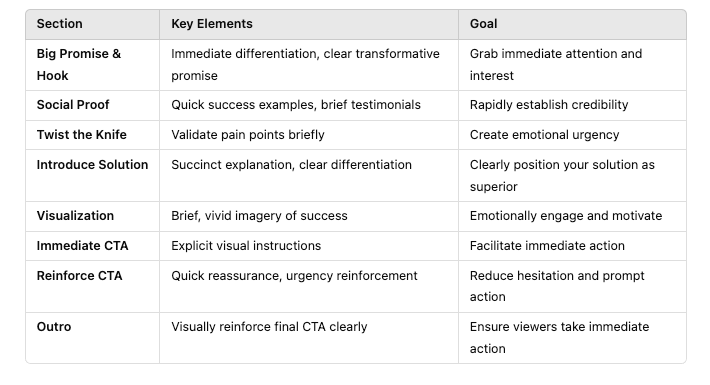
Section 1: Big Promise and Sharp Hook (0:00–0:30)
Immediately grab attention by delivering a clear, powerful promise that explicitly addresses the most critical desire or pain your viewer wants resolved. Your opening must instantly capture interest by clearly communicating transformational benefits.
Key objectives:
- Instantly highlight a key benefit or unique outcome your viewer wants.
- Clearly differentiate your offer in the first few seconds.
- Create immediate curiosity to keep viewers engaged.
Section 2: Social Proof & Credibility (0:30–1:00)
Quickly build trust by showcasing concise yet compelling examples of successful results from clients similar to your viewers. The goal here is swift credibility establishment.
Key objectives:
- Concisely demonstrate proven success and tangible outcomes.
- Quickly build trust without extensive detail.
- Reinforce viewer confidence in your credibility.
Section 3: Twist the Knife (Pain Points) (1:00–1:30)
Directly remind viewers of their current pain points or frustrations clearly and briefly. Use this section to validate their experiences, reinforcing emotional urgency and emphasizing why they need your solution immediately.
Key objectives:
- Directly validate current struggles and emotional frustrations.
- Briefly remind viewers of previous ineffective attempts.
- Heighten emotional urgency and readiness for change.
Section 4: Clearly Introducing the Solution (1:30–3:00)
Clearly present your unique solution, focusing explicitly on how and why your specific mechanism or method works differently and better than competitors. Since your audience is sophisticated, succinctly differentiate your product clearly and compellingly.
Key objectives:
- Clearly differentiate your unique mechanism from competitors.
- Succinctly explain how your product solves problems effectively.
- Highlight unique and superior attributes quickly.
Section 5: Quick Visualization – “Imagine This” (3:00–3:45)
Provide a brief, powerful visualization that quickly engages viewers emotionally by showing the tangible benefits they’ll enjoy after implementing your solution. Create a vivid and compelling emotional picture in their mind.
Key objectives:
- Quickly and powerfully evoke positive emotions and outcomes.
- Enable viewers to emotionally experience success briefly.
- Reinforce viewer motivation through emotional visualization.
Section 6: Immediate Call-to-Action & Clear Next Steps (3:45–4:30)
Clearly and explicitly outline the exact steps viewers must take next. Show the process visually if possible (e.g., screen-sharing the funnel), removing ambiguity and making it as easy as possible for the viewer to take immediate action.
Key objectives:
- Clearly demonstrate exactly what the next step involves.
- Remove any ambiguity or confusion.
- Create an effortless transition into action.
Section 7: Reinforcing Second Call-to-Action (4:30–5:30)
Quickly reinforce the viewer’s decision by clearly reiterating your main promise, urgency, and the benefits of immediate action. Provide an additional moment of reassurance to overcome hesitation.
Key objectives:
- Reinforce confidence in taking action now.
- Quickly reemphasize urgency and scarcity.
- Clearly restate the benefits they’ll achieve by acting promptly.
Section 8: Succinct Outro (5:30–6:00)
End the VSL succinctly, reinforcing the call-to-action visually. Use directional cues like arrows, highlights, or bold text prompts that clearly indicate exactly where and how viewers should act.
Key objectives:
- Clearly restate and reinforce your final CTA.
- Leave no ambiguity about how to proceed.
- Provide a strong visual directive for immediate action.
When and Why to Use a Short-form VSL
Use a Short-form VSL when:
- Your market is sophisticated and familiar with available solutions (Stages 3-5).
- Your prospects clearly understand their problems and have likely tried other solutions.
- You need to differentiate quickly and drive immediate action.
Advantages of Short-form VSL:
- Highly focused and concise, effectively holding attention.
- Quickly differentiates your solution clearly and effectively.
- Streamlined and direct messaging reduces friction and encourages immediate response.
Summary of Short-form VSL Structure:
Long-form VSL (15+ minutes)
A Long-form Video Sales Letter is designed for less sophisticated or newer markets that require extensive education, thorough explanation, and emotional engagement.
This structure typically aligns best with prospects at Stages 1-2 of Market Sophistication and audiences who are Unaware, Problem Aware, or early Solution Aware.
In markets with lower sophistication, viewers have less familiarity with the problem or potential solutions. As a result, the long-form VSL guides prospects carefully through an emotional journey, first recognizing their current challenges, clearly outlining their desires, and finally presenting your solution as the logical, definitive choice.
Long-form VSL Structure
Section 1: Opening
The opening section immediately establishes an emotional connection and builds empathy by addressing viewers’ past experiences, current situations, or actions they have previously attempted (and failed) to achieve desired results.
- Acknowledge Past and Current Struggles:
Begin with relatable scenarios or frustrations your audience is facing. This instantly makes your viewers feel understood. - Establish Connection and Empathy:
Clearly articulate where the viewer currently stands, emphasizing their emotional state and struggles to build instant rapport.
Example:
“There was a time when playing the guitar felt effortless, when it seemed you were on the verge of something great. You could feel the music inside you. It wasn’t perfect, but it was promising.”
Section 2: Desire
In this critical middle section, you vividly illustrate your prospect’s desired outcomes and create strong emotional appeal by painting a clear and compelling picture of what success looks like for them.
- Build Strong Emotional Appeal:
Clearly articulate deep emotional desires and aspirations of your audience. Reinforce what achieving these goals would feel like. - Vivid Visualization (Future Pacing):
Create vivid, compelling visualizations of what achieving their desired outcome would mean, both emotionally and practically. Help them experience their success emotionally, as if it has already happened. - Address Common Objections and Reinforce Beliefs:
At this stage, proactively address common hesitations or skepticism, reinforcing the feasibility and urgency of achieving their desired outcomes. - Urgency and Emotional Investment:
Reinforce why it’s crucial for the viewer to act now and not postpone pursuing their desired state. - Purpose of the Desire section:
To emotionally prime your audience, deepen their desire, and increase their psychological readiness to accept your solution as the best path forward.
Section 3: Solution
Now, with emotional investment and trust established, clearly introduce your product or service as the definitive solution to their stated problems. Provide extensive explanations, clear demonstrations of your unique mechanism, and thorough credibility-building.
- Introduce Your Unique Solution Clearly:
Clearly articulate your solution, explaining explicitly how it works, its unique mechanism, and precisely how it solves their articulated problems better than previous solutions they may have tried. - Explain How and Why Your Solution Works:
Thoroughly differentiate your product or service from alternatives. Explain why your unique mechanism succeeds where previous methods or competitors have failed. - Extensive Social Proof and Credibility:
Back your claims with comprehensive social proof, detailed testimonials, extensive case studies, or quantitative results to build trust and reinforce credibility. - Risk Reversal (Guarantees):
Clearly outline any guarantees, risk reversals, or assurances that remove hesitation or reduce perceived risk, making it easier for the viewer to commit to action. - Detailed Visualization and Future Pacing:
Further solidify your solution’s appeal by helping viewers vividly visualize their life transformed by your product or service, cementing emotional commitment and desire. - Comprehensive and Reinforced Call-to-Action:
Provide clear, explicit instructions about exactly what viewers should do next, leaving no ambiguity. Reinforce urgency and clearly communicate the benefits of immediate action.
Example elements:
- Extensive and detailed product explanations
- Clear explanations of why previous solutions fell short and why your product uniquely succeeds
- Extensive, credible success stories, testimonials, and proven results
- Explicit, step-by-step instructions for taking immediate action
When and Why to Use a Long-form VSL
Use a Long-form VSL when:
- Your audience has lower market sophistication (Stages 1-2).
- Your product category is new, unfamiliar, or requires thorough education.
- Prospects are Unaware, Problem Aware, or early-stage Solution Aware.
Advantages of Long-form VSL:
- Provides extensive education and deeper emotional engagement.
- Builds substantial trust, credibility, and authority.
- Offers the opportunity to fully address objections and reduce skepticism comprehensively.
Quick Reference – The Difference Between the Short-form and Long-form VSL:
Optimizing Your VSL: Pro Tips & Best Practices
Creating your Video Sales Letter is just the beginning. To truly achieve remarkable results and continuously improve your conversions, you need to regularly optimize your VSL based on accurate data, actionable insights, and industry best practices.
Optimizing your VSL involves closely monitoring specific performance metrics, clearly defining key performance indicators (KPIs), and applying strategic improvements through systematic testing and ongoing adjustments. Here’s exactly how you do it effectively.
Key Metrics to Monitor (In-depth)
When optimizing your VSL, there are three primary performance metrics you should track closely:
- Average % Time Watched
- Average Watch Time
- Start % (Views/Impressions)
Let’s dive deeper into each of these metrics individually, explaining their significance, interpretation, and optimal targets.
1. Average % Time Watched
Definition: Average % Time Watched indicates how much of your VSL viewers watch, on average, as a percentage of the total video length.
Why It Matters:
- This metric is a direct indicator of viewer engagement. A high average % watched shows your message is captivating and relevant, keeping viewers interested throughout.
- A low percentage indicates where viewers typically lose interest, helping you pinpoint segments that might require adjustments or improvements
Interpreting the Data:
- <40%: Severe engagement issues, your audience isn’t finding the content relevant or engaging enough.
- 40%-60%: Moderate engagement, but significant room for improvement. Look specifically at viewer drop-off points.
- >60% (Goal): Strong engagement, indicating clear messaging and compelling delivery. Strive to maintain and surpass this benchmark.
Optimizing Strategy:
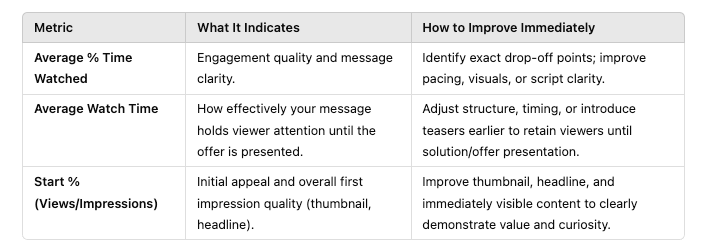
- Clearly identify drop-off segments and critically analyze content quality or clarity at those timestamps.
- Improve pacing, introduce better visual elements, storytelling, or more compelling transitions.
2. Average Watch Time
Definition: Average Watch Time is the average duration viewers spend watching your VSL. It’s measured in minutes and seconds, providing a concrete snapshot of actual engagement duration.
Why It Matters:
- Provides precise insight into how much of your content viewers consume before disengaging.
- Directly influences your ability to deliver your core message, especially your product introduction or CTA.
- If your average watch time is below the point where your product or solution is introduced, you’re losing potential conversions.
Interpreting the Data:
- If your VSL introduces the solution/offer at around 4 minutes, and the average watch time is 2 minutes, many prospects aren’t even seeing your product presentation.
- Ideal watch time should exceed the timestamp at which your solution or primary CTA appears, ensuring most prospects see your complete offer.
Optimizing Strategy:
- Introduce the offer earlier if viewers consistently drop off before your current offer placement.
- Refine your content structure, clearly enhance your storytelling, or make earlier sections more concise and compelling.
- Use strategic teasers early on to ensure viewers remain engaged until the offer appears.
3. Start % (Views / Impressions)
Definition: Start % (Views/Impressions) measures the percentage of people who actually start watching your video after landing on the page (impression).
Why It Matters:
- Reflects the effectiveness of your initial impression, thumbnail, headline, and overall page design.
- A high start % demonstrates strong initial appeal, indicating successful messaging and visual engagement.
- A low start % means potential prospects see your video, but they aren’t intrigued or motivated enough to click play.
Interpreting the Data:
- <70%: Indicates significant issues with your initial presentation, thumbnail, or headline.
- 70%-90%: Good performance, but there’s room to optimize and capture more viewers.
- >90% (Goal): Indicates strong visual appeal and messaging alignment. This ensures maximum prospects engage with your message right from the start.
Optimizing Strategy:
- Experiment with stronger, more compelling thumbnails, clearly communicating the benefits or intriguing curiosity.
- Refine your headline or subheadline to better address core desires or benefits immediately visible to prospects.
- Consider adding persuasive elements like social proof, bold claims, or intriguing questions clearly near the video to improve visual interest and relevance.
Clearly Defined KPIs (Benchmark Targets)
To ensure your VSL remains highly engaging, clearly communicates your message, and effectively converts prospects into customers, aim to meet or exceed these benchmarks:
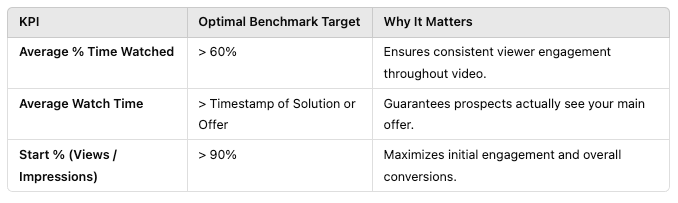
Consistently achieving these KPI targets clearly demonstrates your VSL messaging and delivery are compelling, clearly structured, and highly effective.
Leveraging Metrics to Optimize Your VSL (Summary Table)
Here’s a concise summary table of the key metrics, interpretation, and immediate actions you can take to optimize your VSL:
Continuous Measurement & Optimization
These three metrics provide precise, actionable insight into your VSL’s effectiveness. Regularly review this data, identify trends, and systematically apply refinements to your messaging, visuals, structure, and initial impressions.
By consistently monitoring these critical metrics in-depth and strategically adjusting your approach based on clear data-driven insights, you’ll ensure your VSL continuously improves, driving higher viewer engagement, clearer communication, and significantly inc